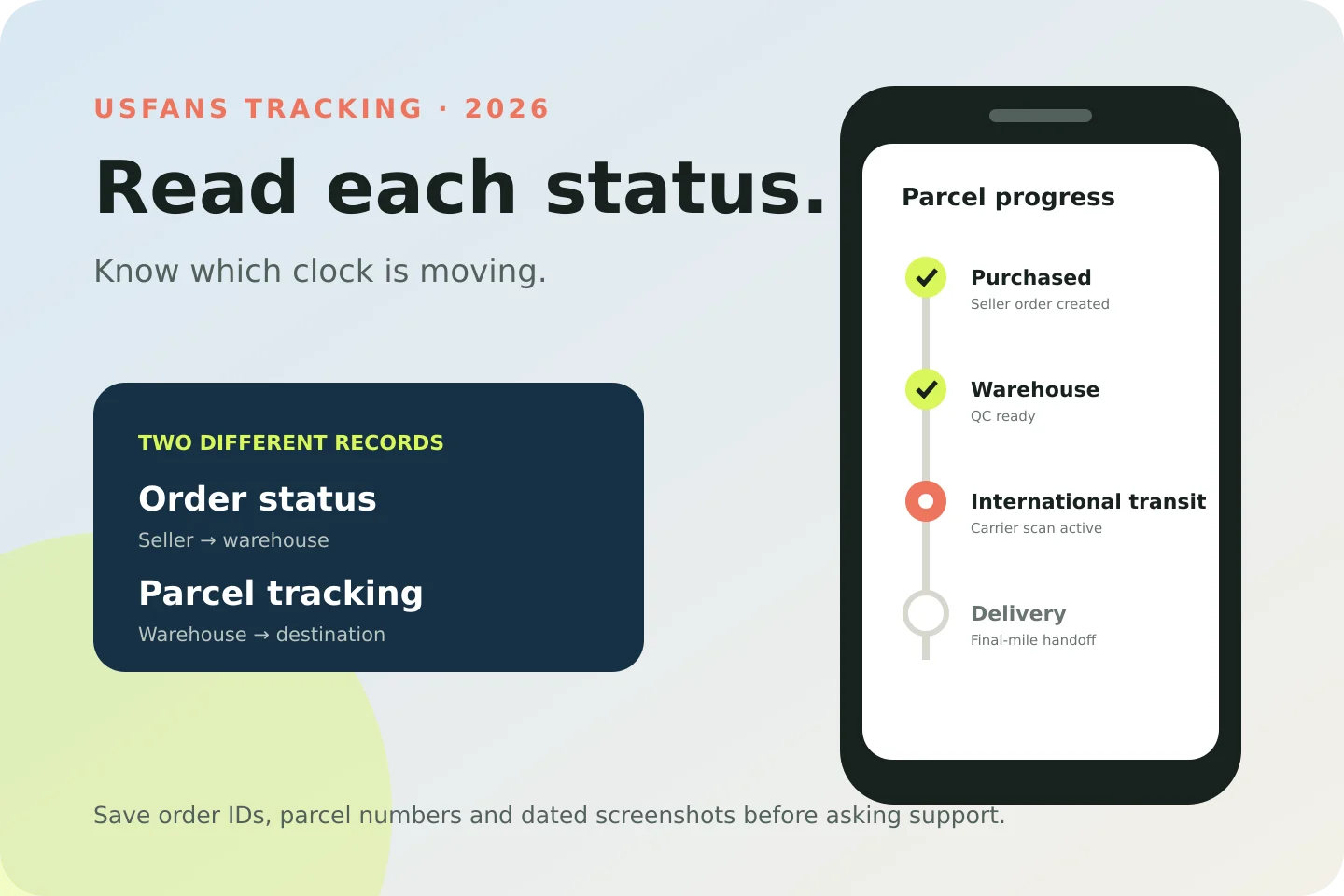
USFans tracking becomes much easier when you stop looking for one number that covers the entire purchase. Before warehouse arrival, you are following a product order and its Chinese domestic shipment. After parcel submission, you are following a new international shipment with its own parcel ID, carrier number and logistics events.
The official USFans service and app describe order management and logistics tracking across the buying journey. The practical challenge is choosing the correct record and interpreting what each update proves. A status label is useful evidence, but it is not always a live GPS position.
1. Know the four identifiers
The product order number identifies a purchase from a marketplace seller. A Chinese domestic tracking number follows the seller’s package to the USFans warehouse. The USFans parcel number identifies the consolidated international shipment you create later. Finally, the international carrier number follows the packed parcel through export, line haul, customs and final delivery.
One parcel can contain several product orders, and one order can sometimes be split into more than one package. Save all four identifiers when they exist. If you ask a carrier about a product order number, or ask warehouse staff about a final-mile exception without the parcel number, the search may return nothing.
2. Payment pending or order submitted
An initial status such as payment pending, submitted or awaiting confirmation means the request exists but the seller purchase may not be complete. Check whether the payment succeeded, whether the amount includes Chinese domestic delivery and whether the selected variation is valid. Duplicate attempts can create several records, so match the amount and timestamp before paying again.
If the product page changed or the seller requires clarification, the order may wait for your response. Read any enquiry or warning rather than assuming the system is delayed. A concise answer that repeats the exact color, size, model and substitution rule is easier to process.
3. Purchasing, purchased and seller processing
“Purchasing” usually means an agent is placing or confirming the marketplace order. “Purchased” indicates that the seller order has been created, but it does not mean the item is already travelling. Sellers can need time to prepare stock, and pre-sale or customized goods may have a longer dispatch window.
At this stage, the most useful evidence is the USFans order number and the seller’s expected dispatch information. If the listing promised a specific lead time and that window has passed, ask whether stock is confirmed and whether the seller has provided a real domestic tracking number.
4. Seller shipped and domestic transport
A seller can upload a tracking number before the local carrier collects the package. The first physical acceptance or facility scan is stronger evidence than “shipment information received.” Domestic scans then show movement toward the warehouse. Some events appear only in Chinese or are summarized inside the order record.
Do not compare this stage with an international delivery estimate. The product is still travelling within China. If scans stop, use the domestic number and last location. The marketplace seller or domestic carrier controls this leg, although the agent may need to contact them on your behalf.
5. Delivered to warehouse versus stored
A domestic carrier’s “delivered” event means the package reached a receiving point. The warehouse still has to identify the order, open or process the package, record measurements and attach it to your account. During busy periods there can be a gap between carrier delivery and visible warehouse storage.
If the gap becomes unusual, prepare the product order number, domestic tracking number, delivery date and any proof of recipient or warehouse signature. This is a warehouse-intake question, not an international tracking problem.
6. Warehouse received, QC ready and return decision
Once stored, the order should show warehouse details and inspection evidence. USFans publicly advertises three to seven free HD QC photographs. Compare them with the saved listing and option: quantity, color, size label, model, visible condition, print placement, accessories and packaging.
Current product pages state that a return can be requested within five days of warehouse arrival, subject to seller negotiation and item terms. Act quickly when the wrong product or a visible defect appears. A pending return should be resolved before the item is selected for international shipping.
7. Parcel submitted, packing and shipping payment
Submitting a parcel creates a new record. The warehouse may consolidate products, remove packaging, reinforce the box, measure final dimensions and calculate chargeable weight. The amount paid at submission may be a deposit that is reconciled after packing. If the balance is unpaid, handoff can pause even though the parcel page exists.
A parcel number is therefore not always a carrier number. During preparation, track warehouse events and packing completion. Repeatedly changing packaging instructions can reset work or create confusion, so use one clear brief before submission.
8. Label created, information received or awaiting acceptance
These events usually mean shipment data has been sent to a logistics provider. They do not prove the parcel is on an aircraft or even physically scanned by the international carrier. The warehouse may be transferring parcels to an export consolidator, or the line may be building a dispatch batch.
Watch for an acceptance, collection or facility event. A short quiet period can be normal. If it exceeds the line’s published handling window, ask USFans for the handoff date, logistics provider and usable carrier number rather than reporting that “tracking is broken.”
9. Export processing and international transit
After acceptance, events may show export sorting, security screening, departure, arrival at a transit hub or destination-country entry. Some consolidated routes provide sparse scans and upload several events together. A parcel can be moving even when public tracking has not refreshed.
Time zones can make events appear out of order. Carrier systems may also translate the same milestone differently. Focus on the dated sequence, facility country and whether the next expected border or handoff has occurred. Do not assume every repeated “in transit” line represents a new physical location.
10. Customs clearance
Customs events can include data received, inspection, duties assessed, documents requested, release or handoff. A tax-inclusive route affects how charges may be handled but does not remove the possibility of review. If information is requested, respond through the official channel and verify the parcel number before sharing documents.
A long customs pause needs different evidence from a missing warehouse scan. Record the destination gateway, arrival date, current event and any notice from the carrier. The carrier or customs broker often has more direct information at this stage than seller-order support.
11. Final-mile handoff and delivery
After clearance, a local postal service or courier may receive the parcel. The international number can remain active, or a new final-mile number can appear. Add the local number to your record and check the recipient address, postcode, apartment and telephone details.
“Out for delivery” means a delivery attempt is planned, not guaranteed. If the status becomes exception, address problem, held for collection or delivery attempted, contact the final-mile carrier promptly. Collection windows can be short. After “delivered,” save proof of delivery and check safe places, reception desks and household members before opening a missing-parcel case.
12. Why tracking can stop updating
- The seller created a number but has not given the package to the domestic carrier.
- The domestic package was delivered but is waiting for warehouse intake.
- The parcel is being packed, weighed or reconciled before international handoff.
- Electronic data exists, but the carrier has not scanned the physical parcel.
- A consolidated route is moving between hubs without public events.
- Customs is processing the shipment or waiting for information.
- The parcel changed from an international provider to a final-mile carrier.
- A system posted events in a delayed batch or under a secondary number.
13. Build a useful tracking evidence file
Keep one short timeline for every shipment. Record the product order numbers, domestic numbers, warehouse arrival dates, parcel submission date, packing or payment completion, international number, carrier acceptance, customs entry and final-mile number. Add screenshots of important events and notices.
This file prevents repeated explanations and reveals which clock has actually stopped. It also protects against a tracking page changing or dropping older events. Do not post the full numbers publicly; share them only with the official support or carrier channel that needs them.
14. Who to contact at each stage
Before seller dispatch, use the product-order enquiry and ask about stock or purchase confirmation. During Chinese domestic transport, use the order number and domestic tracking number. After a carrier says delivered but the item is not stored, ask warehouse intake. During packing or balance reconciliation, ask parcel support. After international acceptance, start with the logistics provider or the platform’s parcel support. For final-mile exceptions, contact the local carrier.
State the last dated event and the expected next event. “Domestic carrier delivered on 12 September; warehouse record still absent on 16 September” is actionable. “Where is my haul?” is not.
Frequently asked questions
Where is my USFans tracking number?
The international number belongs to the submitted parcel. Open the parcel or logistics record after packing and handoff; it is separate from the product order number.
Why does tracking show no update?
The shipment may be waiting for seller dispatch, warehouse intake, packing, carrier acceptance, a consolidated scan, customs processing or final-mile data.
What is the difference between an order and a parcel?
An order tracks one product from seller purchase to warehouse. A parcel tracks one international shipment that may contain several approved orders.
Can a tracking number change?
Yes. A route may add a final-mile number or use different numbers for a consolidator and local carrier. Keep the USFans parcel ID as the stable reference.
When should I contact support?
Escalate when the current stage exceeds its stated or reasonable window, and include the correct ID, last dated event, destination and expected next step.
Final takeaway
Good USFans tracking is a chain of evidence. Follow the order number to the warehouse, approve the item, then follow the parcel number and carrier number to delivery. When an update pauses, identify the current owner of the package before contacting support. That one habit turns a vague delay into a specific, solvable question.