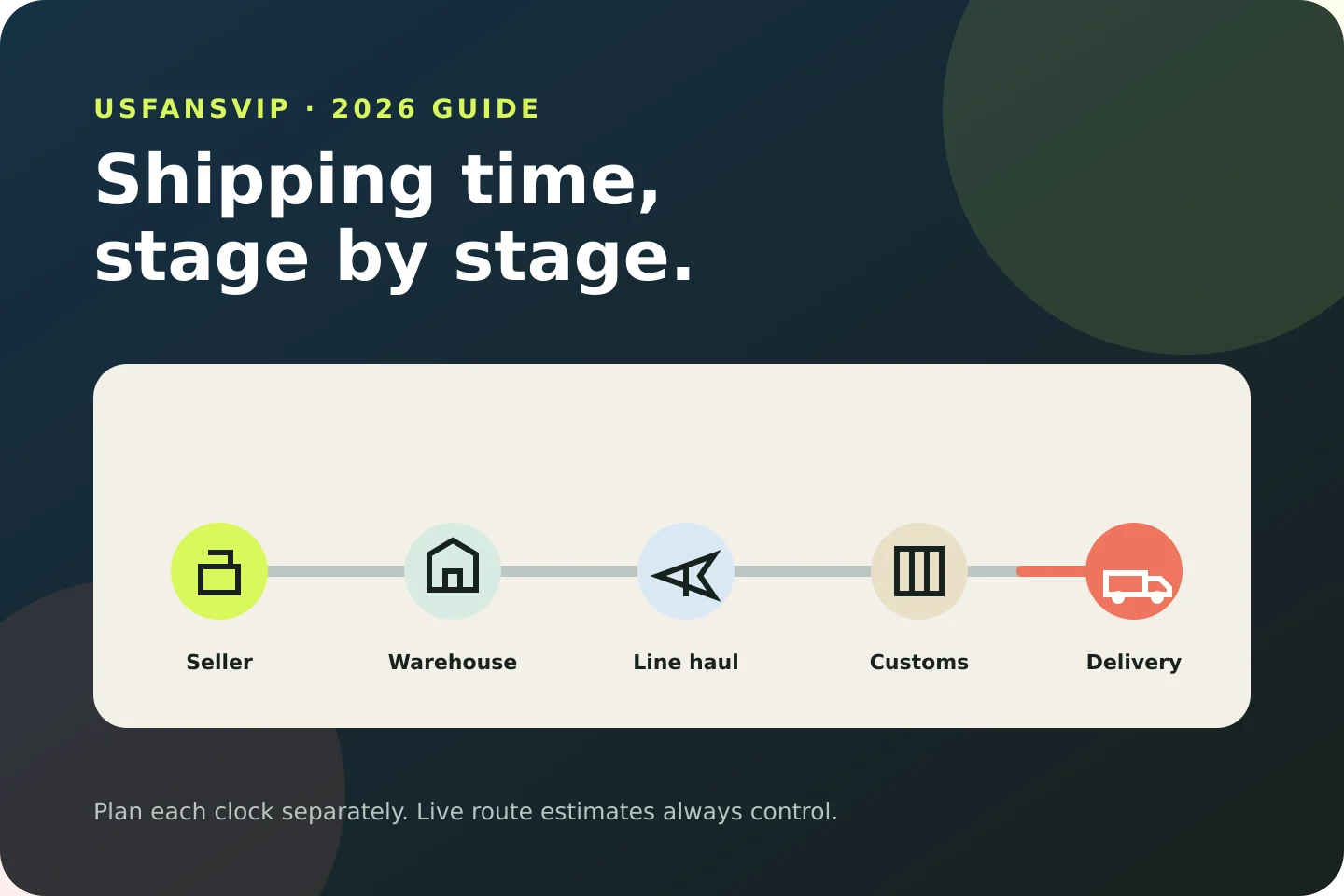
“How long does USFans take?” sounds like a simple question, but a USFans order does not move through one continuous delivery service. A seller first processes the product and sends it within China. The warehouse receives and photographs it. You decide whether to keep, return or consolidate it. Only then can a parcel be packed, measured, assigned to an international route and handed to a carrier.
This distinction explains most confusing estimates. A line that advertises a transit range is normally describing the international part after handoff, not the days spent waiting for a seller, warehouse inspection, parcel rehearsal or payment. A useful plan gives each stage its own clock and adds a buffer for customs and handoffs.
1. Start the clock at the right event
Product payment is not the start of international shipping. At that point USFans still has to purchase or confirm the order, and the marketplace seller still has to dispatch it to the warehouse. If several products come from different sellers, every item follows its own domestic schedule. The slowest item can hold back a consolidated parcel even when the other products are ready.
The international estimate becomes relevant after the parcel has been submitted, packing choices have been applied, the final weight and dimensions are known, any shipping balance is settled, and the logistics provider accepts the parcel. A label created before the first scan may show that data was transmitted, not that the parcel is already travelling.
2. Seller processing and Chinese domestic delivery
The first stage belongs mainly to the seller. A stocked item may be dispatched quickly, while a pre-sale, customized size, restock or unclear variation can take longer. A seller can also create a domestic tracking number before handing the package to the local carrier. Treat “shipped” as progress, but use the carrier scans to confirm physical movement.
Domestic transport within China then carries the item to the USFans warehouse. Weekends, marketplace promotions and regional weather can slow this stage. If an order remains at the purchasing or seller-processing stage, international route speed is irrelevant. Ask about the exact product order rather than the future parcel.
3. Warehouse intake, QC and your decision
After delivery, the warehouse has to match the incoming package to the order, record its weight or dimensions and publish inspection information. USFans publicly describes three to seven free HD inspection photos for warehouse items. Those images are a decision point: verify the selected color, size, quantity, visible condition and important details before building the parcel.
Current USFans product pages also state that a return can be requested within five days after warehouse arrival, subject to seller negotiation and the listing’s conditions. That makes prompt QC review important. Waiting several days to inspect photographs can use up the most practical return window and extend the overall delivery calendar.
USFans promotes up to 90 days of free warehouse storage. Storage is useful for consolidation, but it should not be confused with processing time. If you deliberately wait for another seller, those days are part of your plan even though the platform is not delaying a finished parcel.
4. Consolidation and parcel preparation
A consolidated shipment starts only when all selected items are eligible and approved. Before submitting, decide whether retail boxes are necessary, whether fragile goods need reinforcement and whether different item types can use the same route. Batteries, liquids, cosmetics, food and branded or otherwise restricted goods may reduce route availability.
The warehouse then packs the items and determines the parcel’s actual and volumetric measurements. A bulky light parcel can be charged by dimensional weight, so removing unnecessary packaging may change both price and available line. Repacking, reinforcement, vacuum packing or a split-parcel request adds useful work but can also add processing time. Make these choices once, clearly, instead of changing instructions after packing begins.
5. International acceptance and line-haul transit
Once the parcel leaves the warehouse, it may move through an export facility before the first recognizable international scan. Some routes show electronic data immediately and physical acceptance later. Others consolidate multiple parcels before departure. A quiet tracking page during this interval does not automatically mean a lost package.
Route names such as express, priority, tax-inclusive or economy describe different service designs. Faster lines often have tighter size and item rules. Economy lines may trade speed for a lower price. USFans advertises service to more than 200 destinations, but the lines offered to one parcel still depend on destination, chargeable weight, dimensions and product attributes.
6. Customs and the final-mile carrier
Customs is not a fixed number of days. A parcel may clear from submitted electronic data, or it may wait for inspection, tax assessment or extra information. Destination holidays, backlogs and inaccurate declarations can extend this stage. A tax-inclusive route can change how charges are handled, but it cannot guarantee that a parcel will never be reviewed.
After clearance, the shipment may be transferred to a postal service or local courier. The tracking number can stay the same, gain a local number or take time to appear in the final-mile system. The last-mile carrier controls delivery attempts, address exceptions, collection deadlines and proof of delivery.
7. Country-by-country planning ranges
The ranges below are conservative buyer-planning bands for the international portion after carrier acceptance. They are not official USFans promises and do not include seller processing, warehouse waiting or parcel preparation. A live route quote for your exact parcel should always replace these broad bands.
- United States: plan roughly 7–15 business days for a priority-style route and 12–30 business days for an economy-style route after acceptance.
- United Kingdom: plan roughly 7–14 business days for priority service and 12–25 business days for economy service, with extra time possible around customs or public holidays.
- Germany and nearby EU destinations: plan roughly 8–16 business days for priority service and 14–30 business days for economy service. VAT and customs data quality can affect handoff.
- Canada: plan roughly 8–18 business days for priority service and 15–35 business days for economy service, especially for addresses far from major gateways.
- Australia: plan roughly 8–18 business days for priority service and 15–30 business days for economy service, then allow for long domestic final-mile distances.
8. What usually makes a USFans order late
The most common delay is waiting for a seller or one missing item in a multi-seller haul. Other causes include an unclear variation, a warehouse return, a request for extra measurements, repeated packing changes, sensitive-goods restrictions, volumetric-weight recalculation, an unpaid shipping difference, a route capacity pause, export security checks, customs review or a failed final-mile delivery attempt.
These causes happen at different layers. If the item has not reached the warehouse, contact order support with the product order number. If the parcel is packed but not accepted, ask about warehouse handoff. If carrier scans have started, use the parcel number and last scan. Sending the correct identifier prevents support from investigating the wrong clock.
9. How to shorten the controllable part
Choose listings with clear variants and seller terms. Record the exact option and avoid contradictory remarks. Review QC photos on the day they appear. Decide in advance whether boxes can be removed and whether you need reinforcement. Consolidate items with compatible restrictions, and do not wait for a slow seller unless the saving is worth the calendar risk.
Before parcel submission, use the current destination, accurate product attributes and realistic packed dimensions in the route estimator. Keep enough balance to settle a shipping adjustment promptly. Finally, use an address that matches the recipient’s local format and include any required apartment, postcode, telephone or tax identifier.
10. When to ask for help
Escalate when a status exceeds the seller’s stated processing time, domestic tracking has no movement beyond a reasonable local window, a warehouse-delivered package is not matched to the order, a parcel misses the route’s estimated range, customs requests documents, or the final-mile carrier reports an address problem.
Prepare the order number, parcel number, tracking number, last dated scan, destination and a short description of the expected next event. Screenshots are useful when a status later changes. A message such as “parcel submitted twelve days ago” is weaker than a timeline that identifies packing completion, carrier acceptance and the last logistics scan.
Frequently asked questions
How long does USFans shipping take?
There is no single duration. Total time combines seller processing, domestic delivery, warehouse intake and QC, your consolidation decision, packing, international transit, customs and final delivery.
Does a shipping estimate include warehouse time?
Usually not. Treat a route estimate as the international portion after the parcel is ready and accepted unless the live page clearly states otherwise.
Why does tracking say information received?
A label or electronic record may exist before the logistics provider has scanned the physical parcel. Watch for an acceptance or facility scan.
Can the fastest line always carry my products?
No. Route eligibility depends on destination, weight, dimensions and whether the parcel contains sensitive or restricted goods.
Are the country ranges guaranteed?
No. They are broad planning bands. The current route estimate for the final parcel is more relevant, and customs or final-mile events can still add time.
Final takeaway
A useful USFans shipping estimate is built, not guessed. Track the seller, warehouse and parcel as separate records. Review QC quickly, submit one clear packing brief, use the final chargeable weight and read the live route terms. When each clock has a start event and an owner, a quiet status becomes easier to interpret and a delivery plan becomes much more realistic.